
Scented Candle Manufacturers in UAE: Private Label Candle Production
Why Candles Belong in a Fragrance Range
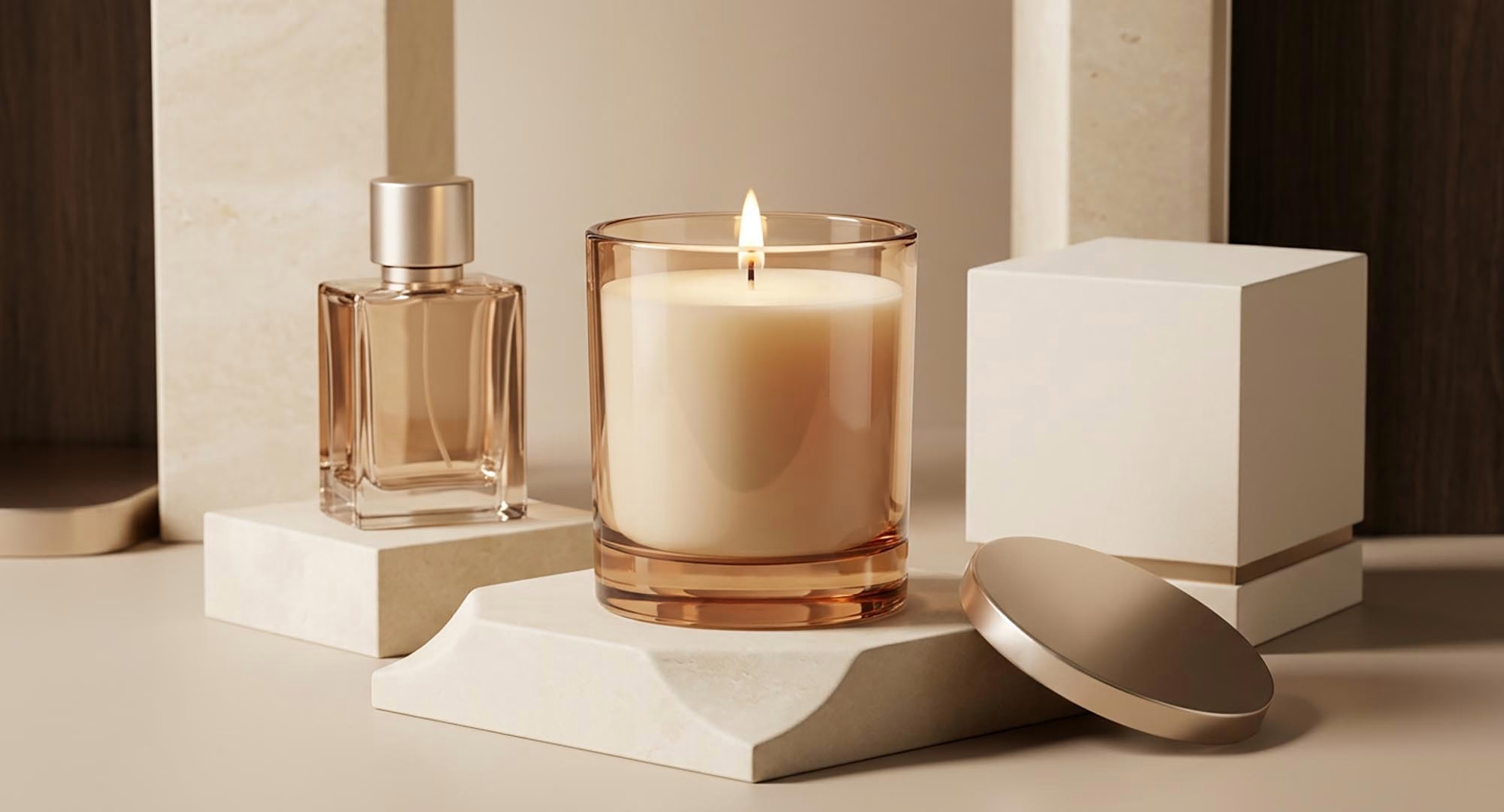
Because the customer is already yours.
Someone who likes how your perfume smells is unusually easy to sell a candle to. The scent is the product, and they have already told you they like it.
Candles also solve a gifting problem. A perfume is a personal choice and risky to give. A candle is safe, universally understood and sits comfortably in a gift box.
There is a practical reason too. A candle occupies a completely different moment from a perfume, which means it does not cannibalise anything you already sell.
For a brand with an established scent, it is one of the most straightforward range extensions available.
It is also more technical than it looks, which is where most first candle projects go wrong.
What Do Scented Candle Manufacturers Produce?
More variety than the category suggests.
- Single-wick container candles. The standard retail product, usually in glass.
- Multi-wick candles. Larger vessels needing more than one wick to burn evenly.
- Travel and tin candles. Smaller formats for gifting and entry price points.
- Coordinated sets. Candles matched to a perfume or a room spray in a shared scent.
IGOP produces candles alongside perfumes, hair mists, body sprays, interior perfumes and fragrance oils, which matters when a single scent needs to run across several product types.
The Thing Nobody Tells First-Time Candle Brands
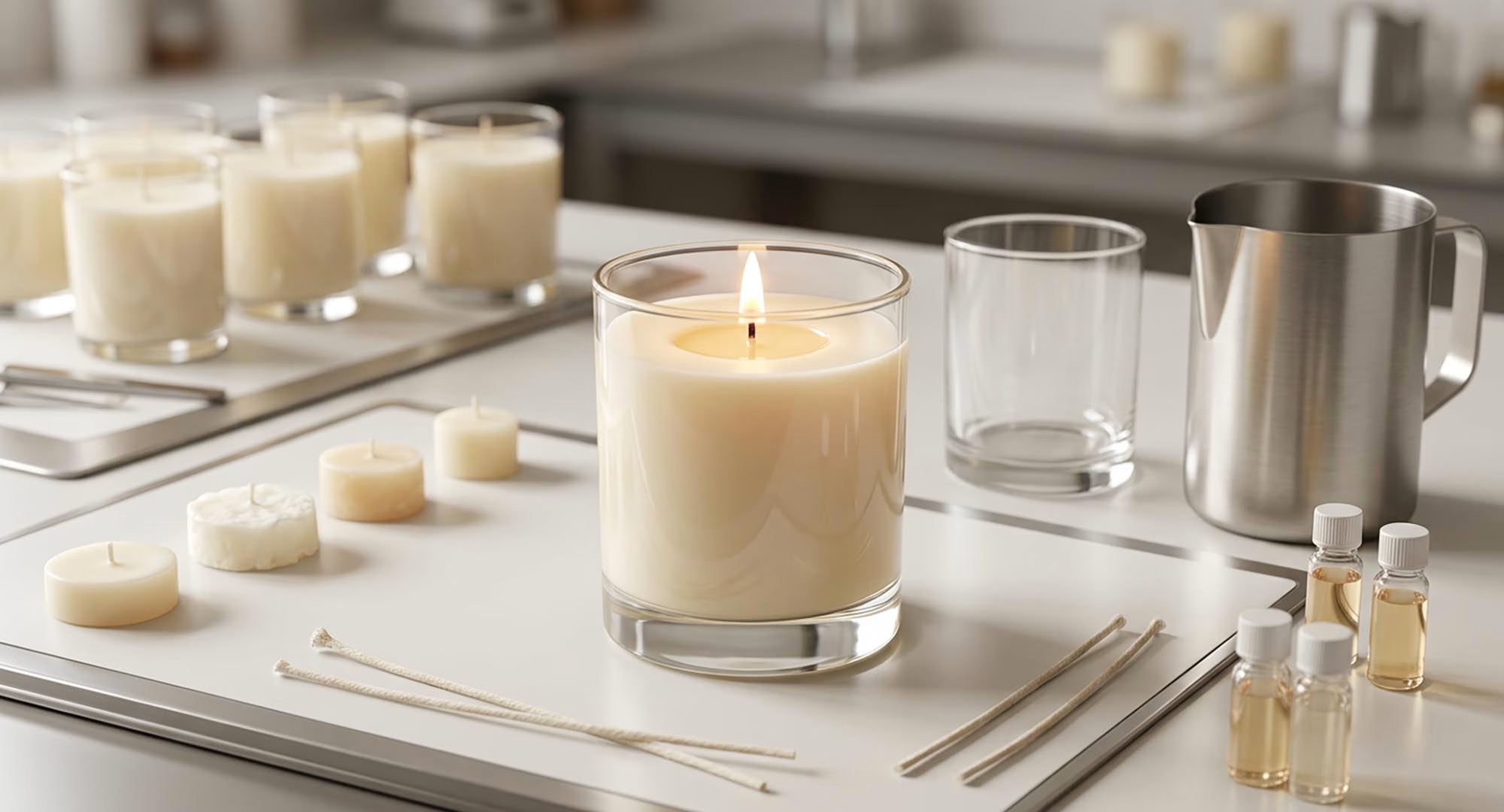
Wax, and Why It Matters
The industry works with several wax types, and each behaves differently.
- Excellent scent throw, consistent, and the most economical at volume.
- Slower, cleaner burn with a softer throw. Popular with natural positioning.
- Coconut and blends. Smooth appearance and good throw, at a higher material cost.
- Blended waxes. Most commercial candles use a blend, tuned for throw, appearance and cost together.
There is no universally best wax. There is a wax that suits your price point, your vessel and the throw you need, and choosing it is a specification conversation rather than a moral one.
Be careful with natural claims on the label. Describe what the product contains rather than implying benefits you cannot substantiate.
Scent Throw Is the Only Thing Customers Judge

And it is the hardest part to get right.
Throw comes in two forms. Cold throw is how the candle smells unlit on a shelf. Hot throw is how it fills a room once burning.
Customers buy on cold throw and judge on hot throw. A candle that smells wonderful in the shop and does nothing when lit produces the worst kind of review.
Fragrance load, the proportion of fragrance oil in the wax, is the main lever. More is not automatically better, because wax can only hold so much before the burn suffers.
Always test a sample candle by burning it for several hours in a normal-sized room, not by smelling it unlit.
Choosing a Vessel
The vessel is the product as far as the customer is concerned.
Glass, Ceramic and Tin
Glass dominates retail because it looks good, holds heat safely and photographs well. Ceramic reads more premium and costs more. Tin suits travel formats and tighter budgets.
Whatever the material, the vessel has to tolerate sustained heat safely. This is a specification question, not an aesthetic one.
Shape Affects the Burn
Wide vessels need more wick power to melt edge to edge. Narrow vessels concentrate heat and can tunnel if the wick is wrong.
Pick the vessel early, because the wick and wax specification are built around it. Changing the vessel later means re-testing the whole system.
How a Candle Project Actually Runs
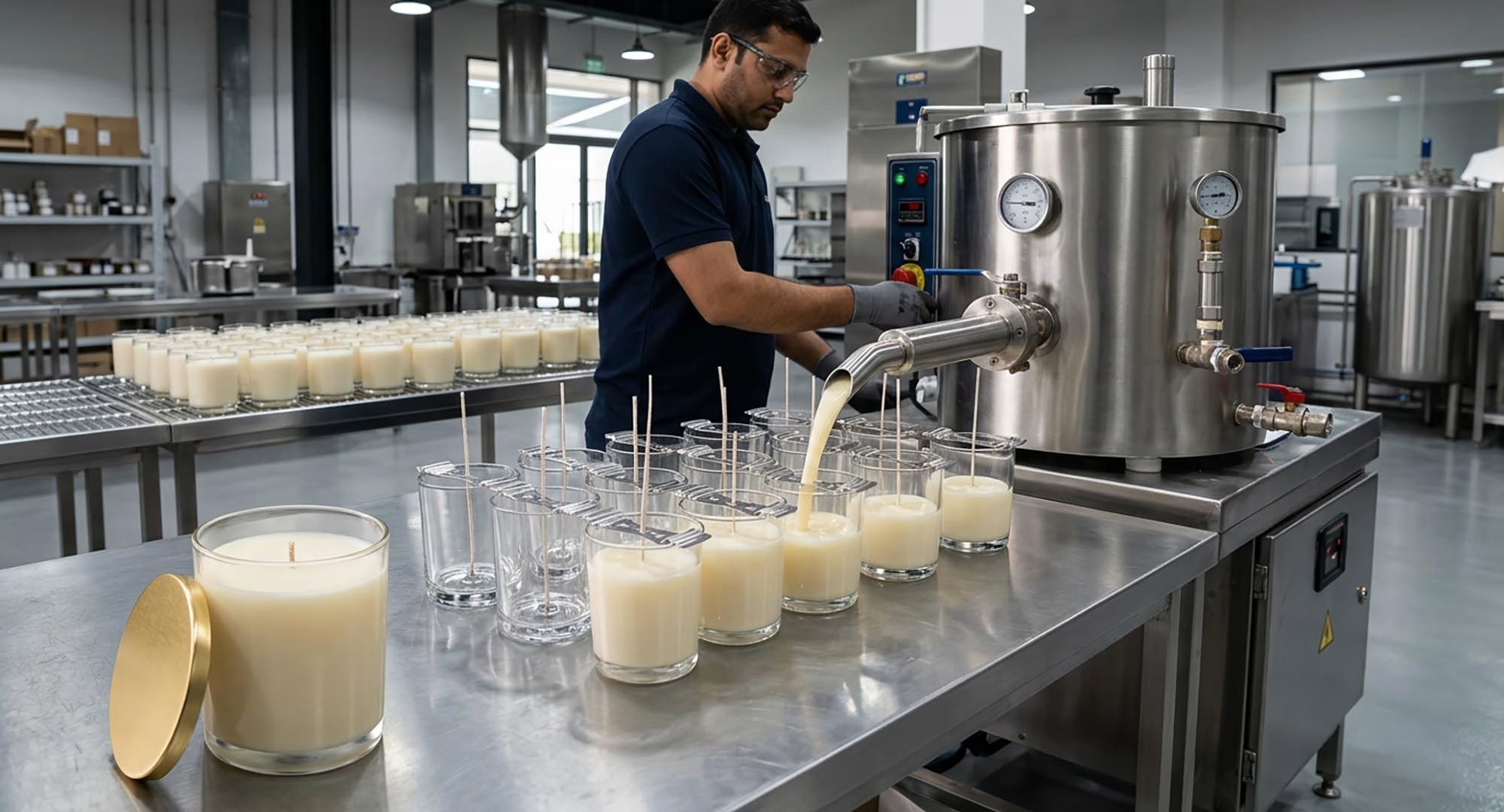
Six steps, and the fourth is where the time goes.
- Scent direction, vessel, size, price point and intended channel.
- Vessel selection. Chosen before wax and wick, because both depend on it.
- Fragrance selection. From an existing library, or matched to a scent you already sell.
- Burn testing. The essential step. Wick, wax and load adjusted until it burns cleanly.
- Pre-production sample. A complete finished candle, burned properly before approval.
- Seven to thirty days once burn testing is signed off.
Burn testing is not a formality and it cannot be rushed. A candle approved without it is a product you have not actually tested.
What Does Private Label Candle Production Cost?
The vessel usually costs more than the contents.
This surprises people. Wax and fragrance are real costs, but a good glass vessel with a lid and a printed box frequently outweighs both.
The drivers, in rough order at retail volumes, are the vessel and lid, then the outer box, then wax volume, then fragrance load, then labelling.
Size matters more than it does in fragrance, because wax volume and vessel cost both scale directly with it. A 200g candle is not marginally more expensive than a 120g one.
Work backwards from your shelf price and let the factory tell you which vessel and which load fit inside it.
Safety and Labelling
Candles carry obligations that perfume does not.
A burning product in a customer’s home needs clear safety information, and most markets expect it on the base or the packaging.
- Burn instructions. First burn to a full melt pool, maximum burn time, trim the wick.
- Safety warnings. Never leave unattended, keep away from children and pets, keep clear of draughts.
- Product information. Weight, burn time and what the candle contains.
Agree who is responsible for label content before artwork is produced. On fragrance materials, the International Fragrance Association publishes the standards most of the industry formulates against.
Sizes, Burn Time and Perceived Value
Three numbers customers actually compare, and only one of them is printed large.
Weight is the usual specification, and most retail candles sit somewhere between 120g and 250g. Below that reads as a travel or sample size. Above it moves into a gifting format.
Burn time is what the customer values, and it follows wax volume and wick size together. A larger candle with an aggressive wick can burn through faster than a smaller, better-specified one.
Perceived value comes from the vessel more than from either. A heavier glass with a well-fitted lid feels worth more than a lighter one holding the same wax.
This is where budget is best spent. Customers hold the vessel long before they light it, and they keep it long after the wax is gone.
Publish burn time honestly. An overstated figure produces exactly the kind of disappointment that follows a brand around.
Candles for Hotels and Corporate Gifting
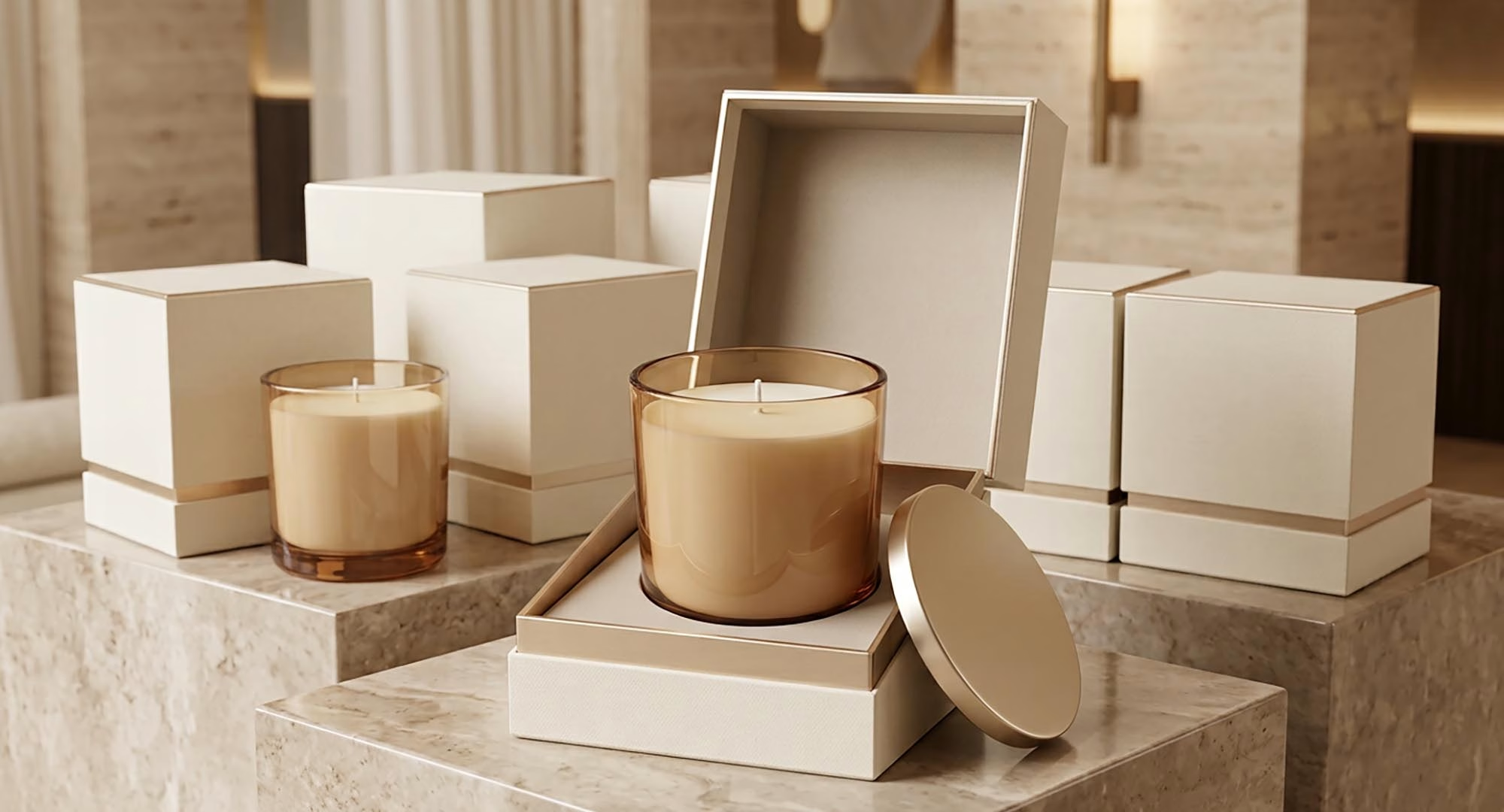
A quieter market than retail, and often steadier.
Hospitality buyers want a scent that matches the rest of a property, supplied consistently across repeat orders, usually in a restrained vessel that suits an interior rather than a shelf.
Corporate gifting works differently again. Quantities are known precisely, the deadline is fixed, and the packaging does most of the communicating.
Seasonal demand concentrates sharply in this market. Ramadan, Eid and the year-end period carry the bulk of gifting volume, and buyers commit three to four months ahead of the window.
If a candle is intended for one of those periods, fix the production cut-off date before discussing anything else.
Minimums and Lead Times
Production runs from around 1,000 units, with the same logic as other private label work.
Vessel choice is the main variable. Selecting a vessel the factory already stocks keeps the minimum low. Commissioning custom glass or ceramic raises it considerably, because tooling costs need volume to absorb.
Add burn testing time at the front of the schedule. It is not long, but it cannot be skipped, and it happens before production time even begins.
The minimum order page covers what moves the figure in each direction.
Coordinating a Candle With Your Other Products
Harder than it sounds, and worth planning properly.
The same fragrance does not smell identical in wax, in a spray and on skin. Each format releases the composition differently, and a scent tuned for one can feel unbalanced in another.
A good factory adjusts the composition for each format rather than using the identical formula across all of them. Ask specifically whether they do this.
Where it works, the payoff is real. A coordinated candle, room spray and perfume feels designed rather than assembled, and it sells as a set far better than three unrelated products would.
The home fragrance page covers the interior side of that range.
Choosing Scented Candle Manufacturers in UAE
Ask about burn testing first. Everything else follows from the answer.
A manufacturer that talks confidently about wick sizing, melt pools and fragrance load is treating the candle as the technical product it is. One that only discusses scent is selling you a jar of wax and hoping.
Ask to burn a sample before approving anything, and give it several hours rather than ten minutes.
Stera Perfumes is one UAE fragrance brand that sells home and gifting formats alongside its core range, which is the usual direction once a scent is established.
IGOP has manufactured fragrance in the UAE for over forty-five years and produces candles alongside perfumes, hair mists, body sprays, interior perfumes and fragrance oils, with packaging components held in-house. The full range is here.
If you already have a scent you want in wax, that is the simplest brief to bring.
FAQ
What is the minimum order for private label candles?
Around 1,000 units at most established manufacturers, with the figure driven largely by your vessel. Choosing a glass or tin the factory already stocks keeps the minimum low, while commissioning a custom vessel raises it because tooling costs need larger volumes to absorb.
Why does my candle smell strong unlit but weak when burning?
That is a difference between cold throw and hot throw, and it usually points to the fragrance load, the wick or the wax being mismatched. Wax can only carry so much fragrance before the burn suffers, so the fix is a specification adjustment found through burn testing rather than simply adding more oil.
Which wax is best for scented candles?
How long does private label candle production take?
Seven to thirty days of production depending on volume, plus burn testing beforehand. Burn testing is the step that cannot be rushed, since wick, wax and fragrance load all need adjusting together until the candle burns evenly and throws scent properly in a normal room.
Can I have a candle made to match my perfume?
Yes, and it is a common request. The composition usually needs adjusting rather than copying directly, because a fragrance releases differently in wax than it does in alcohol on skin. Ask whether the manufacturer reformulates for the format or simply uses the same oil.
READY TO ELEVATE YOUR BRAND'S FRAGRANCE EXPERIENCE ?
READY TO ELEVATE YOUR BRAND'S FRAGRANCE EXPERIENCE ?
READY TO ELEVATE YOUR BRAND'S FRAGRANCE EXPERIENCE ?
Ready to Elevate Your Brand's Fragrance Experience ?
Partner with IGOP and transform your fragrance ideas into market-leading products. Our expertise, capacity, and commitment to quality ensure your vision is realized, exactly the way you want it. Your vision, your budget, our expertise.
